Deprecated: explode(): Passing null to parameter #2 ($string) of type string is deprecated in /home/latinh2/dev.latinhire.com/wp-content/plugins/sitepress-multilingual-cms/inc/functions.php on line 506
Deprecated: explode(): Passing null to parameter #2 ($string) of type string is deprecated in /home/latinh2/dev.latinhire.com/wp-content/plugins/sitepress-multilingual-cms/inc/functions.php on line 506
Deprecated: explode(): Passing null to parameter #2 ($string) of type string is deprecated in /home/latinh2/dev.latinhire.com/wp-content/plugins/sitepress-multilingual-cms/inc/functions.php on line 506
Deprecated: explode(): Passing null to parameter #2 ($string) of type string is deprecated in /home/latinh2/dev.latinhire.com/wp-content/plugins/sitepress-multilingual-cms/inc/functions.php on line 506
https://dev.latinhire.com/es/error-estandar-en-diferencia-de-porcentajes/
Deprecated: Creation of dynamic property WP_Term::$cat_ID is deprecated in /home/latinh2/dev.latinhire.com/wp-includes/category.php on line 378
Deprecated: Creation of dynamic property WP_Term::$category_count is deprecated in /home/latinh2/dev.latinhire.com/wp-includes/category.php on line 379
Deprecated: Creation of dynamic property WP_Term::$category_description is deprecated in /home/latinh2/dev.latinhire.com/wp-includes/category.php on line 380
Deprecated: Creation of dynamic property WP_Term::$cat_name is deprecated in /home/latinh2/dev.latinhire.com/wp-includes/category.php on line 381
Deprecated: Creation of dynamic property WP_Term::$category_nicename is deprecated in /home/latinh2/dev.latinhire.com/wp-includes/category.php on line 382
Deprecated: Creation of dynamic property WP_Term::$category_parent is deprecated in /home/latinh2/dev.latinhire.com/wp-includes/category.php on line 383
Deprecated: explode(): Passing null to parameter #2 ($string) of type string is deprecated in /home/latinh2/dev.latinhire.com/wp-content/plugins/sitepress-multilingual-cms/inc/functions.php on line 506
Deprecated: Constant FILTER_SANITIZE_STRING is deprecated in /home/latinh2/dev.latinhire.com/wp-content/plugins/sitepress-multilingual-cms/classes/request-handling/class-wpml-rest-request-analyze.php on line 61
Deprecated: explode(): Passing null to parameter #2 ($string) of type string is deprecated in /home/latinh2/dev.latinhire.com/wp-content/plugins/sitepress-multilingual-cms/inc/functions.php on line 506
Deprecated: explode(): Passing null to parameter #2 ($string) of type string is deprecated in /home/latinh2/dev.latinhire.com/wp-content/plugins/sitepress-multilingual-cms/inc/functions.php on line 506
Deprecated: preg_replace(): Passing null to parameter #3 ($subject) of type array|string is deprecated in /home/latinh2/dev.latinhire.com/wp-content/plugins/all-in-one-seo-pack-pro/app/Common/Traits/Helpers/Strings.php on line 158
Anahid nos muestra una excelente sesión de estadística, donde trataron el tema del error estándar. Problema: Tutor Welcome! How are you? Student hello! good! Tutor Tell me, what can I do for you today? Student twell, im not sure how to find the standard error…
The post Error estándar en diferencia de porcentajes first appeared on LatinHire Online Tutoring.
]]>Deprecated: explode(): Passing null to parameter #2 ($string) of type string is deprecated in /home/latinh2/dev.latinhire.com/wp-content/plugins/sitepress-multilingual-cms/inc/functions.php on line 506
Problema:

Tutor
Welcome! How are you?
Student
hello! good!
Tutor
Tell me, what can I do for you today?
Student
twell, im not sure how to find the standard error here for a difference in proportions
Tutor
ok, let’s find the proportions first, can you calculate them?
Student
.25 and .125
Tutor
Excellent! You did that step perfectly. the formula for the SE is…
is that familiar to you?
Student
yeah, thats what i thought i originally did, i may have made a calculator error
Tutor
let’s check it together then. well done!
how much is the first term inside the square root?
Student
.0036
Tutor
perfect!
what about the second term?
Student
and .0012
Tutor
well done, if we add them we get 0.00485. right?
Student
and then we square root for .069!
Tutor
perfect!
check that the square root is 0.0696
Student
yup! i got .0693 but i think its close enough
Tutor
if we take the first three digits after the dot, the approximation is 0.070
Great job on that one! Nicely done.
Student
actually, unrounded i did get 696, awesome, thank you for your help!
Tutor
you are welcome , Do you have any questions about anything we went over today?
Student
nope, thanks again!
The post Error estándar en diferencia de porcentajes first appeared on LatinHire Online Tutoring.
]]>Deprecated: explode(): Passing null to parameter #2 ($string) of type string is deprecated in /home/latinh2/dev.latinhire.com/wp-content/plugins/sitepress-multilingual-cms/inc/functions.php on line 506
Deprecated: explode(): Passing null to parameter #2 ($string) of type string is deprecated in /home/latinh2/dev.latinhire.com/wp-content/plugins/sitepress-multilingual-cms/inc/functions.php on line 506
Deprecated: explode(): Passing null to parameter #2 ($string) of type string is deprecated in /home/latinh2/dev.latinhire.com/wp-content/plugins/sitepress-multilingual-cms/inc/functions.php on line 506
Deprecated: explode(): Passing null to parameter #2 ($string) of type string is deprecated in /home/latinh2/dev.latinhire.com/wp-content/plugins/sitepress-multilingual-cms/inc/functions.php on line 506
https://dev.latinhire.com/es/correlaciones-lineales/
Student [00:00:05] if two variables have a “near zero”correlation and you therefore conclude they are unrelated, you are also concluding they are: a)independent of each other b) perfect predictors of each other c) dependent upon each other d)all of the above Tutor [00:00:10] Welcome! My name is Anahid, How are you? Student [00:00:44] hello im great…
The post Correlaciones Lineales first appeared on LatinHire Online Tutoring.
]]>Deprecated: explode(): Passing null to parameter #2 ($string) of type string is deprecated in /home/latinh2/dev.latinhire.com/wp-content/plugins/sitepress-multilingual-cms/inc/functions.php on line 506
[00:00:05] if two variables have a “near zero”correlation and you therefore conclude they are unrelated, you are also concluding they are: a)independent of each other b) perfect predictors of each other c) dependent upon each other d)all of the above
Tutor
[00:00:10] Welcome! My name is Anahid, How are you?
Student
[00:00:44] hello im great how are you?
Tutor
[00:01:04] I’m great too! Thanks
[00:01:11] Tell me, what can I do for you today?
Student
[00:01:34] i wrote the problem up there ^
[00:01:39] i dont know what to do
Tutor
[00:02:00] are you familiar with the concept of correlation?
Student
[00:02:09] yes somewhat.
Tutor
[00:02:31] can you tell me what correlation means?
Student
[00:03:35] its a relationship or connection between two things
[00:03:41] if they are related or not..
Tutor
[00:03:52] that’s right!
[00:04:08] the correlation express the relation between two variables
[00:04:22] so if there is an almost zero correlation
[00:04:31] what that means?
Student
[00:04:57] there is no correlation
Tutor
[00:05:05] that’s right
[00:05:07] !
[00:05:25] here is a web site that can help use to see it better
Student
[00:05:59] ok great, thanks!
Tutor
[00:06:14] can you see the graphs?
Student
[00:06:23] yes
Tutor
[00:06:28] look at the one that says zero correlation
[00:06:49] we have two variables, each one represented by an axis
[00:07:35] can we predict one from the other?
Student
[00:07:56] theyre not related?
Tutor
[00:08:07] that’s right
[00:08:36] we can not predict one from the other
[00:08:49] those dots are random
[00:09:03] Does this problem make sense to you now?
Student
[00:09:27] yes
[00:09:38] but i dont get what independent
[00:09:42] or dependent mean
Tutor
[00:10:15] dependent means that the value of one variable depends on the value of the other
[00:10:23] independent is the opposite
[00:10:38] it means that the variables are not related
Student
[00:10:48] oh so a?
[00:10:51] independent
Tutor
[00:10:56] does this sound familiar to you?
[00:11:03] Great job on that one! Nicely done.
Student
[00:11:02] yes
Tutor
[00:11:15] Perfect! Good work.
[00:11:21] Do you have any questions about anything we went over today?
Student
[00:11:24] thank you!
[00:11:30] no thats it
The post Correlaciones Lineales first appeared on LatinHire Online Tutoring.
]]>Deprecated: explode(): Passing null to parameter #2 ($string) of type string is deprecated in /home/latinh2/dev.latinhire.com/wp-content/plugins/sitepress-multilingual-cms/inc/functions.php on line 506
Deprecated: explode(): Passing null to parameter #2 ($string) of type string is deprecated in /home/latinh2/dev.latinhire.com/wp-content/plugins/sitepress-multilingual-cms/inc/functions.php on line 506
Deprecated: explode(): Passing null to parameter #2 ($string) of type string is deprecated in /home/latinh2/dev.latinhire.com/wp-content/plugins/sitepress-multilingual-cms/inc/functions.php on line 506
Deprecated: explode(): Passing null to parameter #2 ($string) of type string is deprecated in /home/latinh2/dev.latinhire.com/wp-content/plugins/sitepress-multilingual-cms/inc/functions.php on line 506
https://dev.latinhire.com/es/problema-de-acidos-y-bases-sin-ka/
Deprecated: Creation of dynamic property WP_Term::$cat_ID is deprecated in /home/latinh2/dev.latinhire.com/wp-includes/category.php on line 378
Deprecated: Creation of dynamic property WP_Term::$category_count is deprecated in /home/latinh2/dev.latinhire.com/wp-includes/category.php on line 379
Deprecated: Creation of dynamic property WP_Term::$category_description is deprecated in /home/latinh2/dev.latinhire.com/wp-includes/category.php on line 380
Deprecated: Creation of dynamic property WP_Term::$cat_name is deprecated in /home/latinh2/dev.latinhire.com/wp-includes/category.php on line 381
Deprecated: Creation of dynamic property WP_Term::$category_nicename is deprecated in /home/latinh2/dev.latinhire.com/wp-includes/category.php on line 382
Deprecated: Creation of dynamic property WP_Term::$category_parent is deprecated in /home/latinh2/dev.latinhire.com/wp-includes/category.php on line 383
Comentarios del tutor: Algunas veces los estudiantes se conectan preguntando si un ácido o base es débil o fuerte sin tener conocimiento de la constante de disociación. Sin embargo su familiaridad experimental con los ácidos y/o algún conocimiento general les permite resolver estos problemas. Veamos la sesión: Student: which is a stronger base? H2PO4-? or…
The post Problema de Ácidos y Bases (sin Ka) first appeared on LatinHire Online Tutoring.
]]>Deprecated: explode(): Passing null to parameter #2 ($string) of type string is deprecated in /home/latinh2/dev.latinhire.com/wp-content/plugins/sitepress-multilingual-cms/inc/functions.php on line 506

Student: which is a stronger base? H2PO4-? or HSO4-?
Tutor: Hello. Welcome Do you have any idea how you might solve this problem?
Student: hey thanks. Ummm i have sort of one
Tutor: tell me what do you think?
Student: the one with the the less H?
Tutor: that’s an interesting idea but there exists a better criterion. The stronger base comes of the weaker conjugate acid. Let’s see where comes the HSO4-
Student: it would come from SO4 -2. Sorry meant to put the h IN THERE
Tutor: you were almost right but we are considering the reaction starting from an acid. We can set up something similar for the other ion
Student: ohh ok my bad i understand
Tutor: it’s ok. Would you like to set up the same for the H2PO4-? Well done! Have you used the dissociation constants?
Student: I dont think so
Tutor: ok, now the problem is to find the stronger acid. We can do it by two means: using the acid dissociation constant Ka or using our experience working with acids. Maybe you have worked in the lab with sulfuric and phosporic acids, do you know which is stronger?
Student: no i am not aware yet
Tutor: ok, I will teach you, basically the strongest acids are: – sulfuric acid – nitric acid
Student: I know the seven strongest
Tutor: oh, great. Is there both, sulfuric and phosphoric?
Student: sulfuric is one of them but phosphoric no
Tutor: yes, you are right
Student: so it would be H2PO4-? Because it has a weaker acid?
Tutor: yes
Student: and the next question asks which is a weaker base Cl- or NO2- and it would be Cl- right? because HCl is a strong acid
Tutor: right, well done!
Student: alright thanks!!!!!!!!!!!!!!!!!!!!!!!!!!!!! !!!!
Tutor: you are welcome, thanks for using our service. Have a nice night
Student: you too
Colaborador: Diego Tapias, Tutor Colombiano de Química
The post Problema de Ácidos y Bases (sin Ka) first appeared on LatinHire Online Tutoring.
]]>Deprecated: explode(): Passing null to parameter #2 ($string) of type string is deprecated in /home/latinh2/dev.latinhire.com/wp-content/plugins/sitepress-multilingual-cms/inc/functions.php on line 506
Deprecated: explode(): Passing null to parameter #2 ($string) of type string is deprecated in /home/latinh2/dev.latinhire.com/wp-content/plugins/sitepress-multilingual-cms/inc/functions.php on line 506
Deprecated: explode(): Passing null to parameter #2 ($string) of type string is deprecated in /home/latinh2/dev.latinhire.com/wp-content/plugins/sitepress-multilingual-cms/inc/functions.php on line 506
Deprecated: explode(): Passing null to parameter #2 ($string) of type string is deprecated in /home/latinh2/dev.latinhire.com/wp-content/plugins/sitepress-multilingual-cms/inc/functions.php on line 506
https://dev.latinhire.com/es/guia-de-tutoria-online-exitosa/
Resumen de la sesión: Esta sesión contiene elementos que, entre otras cosas, considero ayudan a los tutores a darnos cuenta cuál es el conocimiento previo del estudiante antes de comenzar a resolver un problema. Algo que nos puede orientar es indagar con preguntas como “Has resuelto problemas similares en clase? (Have you worked on similar questions…
The post Guía de Tutoría Online Exitosa first appeared on LatinHire Online Tutoring.
]]>Deprecated: explode(): Passing null to parameter #2 ($string) of type string is deprecated in /home/latinh2/dev.latinhire.com/wp-content/plugins/sitepress-multilingual-cms/inc/functions.php on line 506
Question: A gas has a volume of 225 mL at 755 torr. What volume will gas occupy at 365 torr if the temperature of the gas doesn’t change?
Tutor: Welcome! Let’s get started.
Student: alright
Tutor: Have you worked on similar questions in class before?
Student: i was sick on the day that we went over this so not really
Tutor: oh I see
Tutor: you´ll see that it is a quite straight forward question
Tutor: any formula that you´ve come accross in class befor that could help?
Student: im not sure
Student: p1v1=p2v2
Tutor: excellent! That is the one we need to use
Tutor: this equation was postulated by the scientist Boyle and it is known as Boyle´s law
Tutor: So, how would you use the equation with the given data?
Student: 725 torr X 255mL = 365 torr X x
Tutor: excellent!
Tutor: well done. So, what would be our final answer?
Student: 506.5mL
Tutor: I´m sorry, just to check, P1 is 725 or 755 torr as you posted on the question?
Student: it should be 725
Tutor: oh ok, let me check your answer…
Tutor: your answer is perfect!
Tutor: well done indeed
Tutor: any question about what we did today?
Student: no im good now
Student: Thank you
Tutor: great, no problem. Is there anything else you need help with?
Student: nope
Tutor: ok, so nice talking to you! Have a nice rest of the week!
Tutor: bye!
Student: thanks you too
Student: bye
Colaboradora: Cecilia Labriola Tutora Argentina de Química
The post Guía de Tutoría Online Exitosa first appeared on LatinHire Online Tutoring.
]]>Deprecated: explode(): Passing null to parameter #2 ($string) of type string is deprecated in /home/latinh2/dev.latinhire.com/wp-content/plugins/sitepress-multilingual-cms/inc/functions.php on line 506
Deprecated: explode(): Passing null to parameter #2 ($string) of type string is deprecated in /home/latinh2/dev.latinhire.com/wp-content/plugins/sitepress-multilingual-cms/inc/functions.php on line 506
Deprecated: explode(): Passing null to parameter #2 ($string) of type string is deprecated in /home/latinh2/dev.latinhire.com/wp-content/plugins/sitepress-multilingual-cms/inc/functions.php on line 506
Deprecated: explode(): Passing null to parameter #2 ($string) of type string is deprecated in /home/latinh2/dev.latinhire.com/wp-content/plugins/sitepress-multilingual-cms/inc/functions.php on line 506
https://dev.latinhire.com/es/division-de-polinomios/
Deprecated: Creation of dynamic property WP_Term::$cat_ID is deprecated in /home/latinh2/dev.latinhire.com/wp-includes/category.php on line 378
Deprecated: Creation of dynamic property WP_Term::$category_count is deprecated in /home/latinh2/dev.latinhire.com/wp-includes/category.php on line 379
Deprecated: Creation of dynamic property WP_Term::$category_description is deprecated in /home/latinh2/dev.latinhire.com/wp-includes/category.php on line 380
Deprecated: Creation of dynamic property WP_Term::$cat_name is deprecated in /home/latinh2/dev.latinhire.com/wp-includes/category.php on line 381
Deprecated: Creation of dynamic property WP_Term::$category_nicename is deprecated in /home/latinh2/dev.latinhire.com/wp-includes/category.php on line 382
Deprecated: Creation of dynamic property WP_Term::$category_parent is deprecated in /home/latinh2/dev.latinhire.com/wp-includes/category.php on line 383
Deprecated: Creation of dynamic property WP_Term::$cat_ID is deprecated in /home/latinh2/dev.latinhire.com/wp-includes/category.php on line 378
Deprecated: Creation of dynamic property WP_Term::$category_count is deprecated in /home/latinh2/dev.latinhire.com/wp-includes/category.php on line 379
Deprecated: Creation of dynamic property WP_Term::$category_description is deprecated in /home/latinh2/dev.latinhire.com/wp-includes/category.php on line 380
Deprecated: Creation of dynamic property WP_Term::$cat_name is deprecated in /home/latinh2/dev.latinhire.com/wp-includes/category.php on line 381
Deprecated: Creation of dynamic property WP_Term::$category_nicename is deprecated in /home/latinh2/dev.latinhire.com/wp-includes/category.php on line 382
Deprecated: Creation of dynamic property WP_Term::$category_parent is deprecated in /home/latinh2/dev.latinhire.com/wp-includes/category.php on line 383
Comentario del Tutor: Elegí esta sesión ya que abarca un tema que no es muy usual de ver en Argentina , división de polinomios , por otro lado , en esta sesión el alumno no tenia un problema puntual para resolver , sino que necesitaba practica, esto no es muy común , ya que normalmente los alumnos nos…
The post División de Polinomios first appeared on LatinHire Online Tutoring.
]]>Deprecated: explode(): Passing null to parameter #2 ($string) of type string is deprecated in /home/latinh2/dev.latinhire.com/wp-content/plugins/sitepress-multilingual-cms/inc/functions.php on line 506
Deprecated: explode(): Passing null to parameter #2 ($string) of type string is deprecated in /home/latinh2/dev.latinhire.com/wp-content/plugins/sitepress-multilingual-cms/inc/functions.php on line 506
Deprecated: explode(): Passing null to parameter #2 ($string) of type string is deprecated in /home/latinh2/dev.latinhire.com/wp-content/plugins/sitepress-multilingual-cms/inc/functions.php on line 506
Deprecated: explode(): Passing null to parameter #2 ($string) of type string is deprecated in /home/latinh2/dev.latinhire.com/wp-content/plugins/sitepress-multilingual-cms/inc/functions.php on line 506
Deprecated: explode(): Passing null to parameter #2 ($string) of type string is deprecated in /home/latinh2/dev.latinhire.com/wp-content/plugins/sitepress-multilingual-cms/inc/functions.php on line 506
Deprecated: explode(): Passing null to parameter #2 ($string) of type string is deprecated in /home/latinh2/dev.latinhire.com/wp-content/plugins/sitepress-multilingual-cms/inc/functions.php on line 506
Deprecated: explode(): Passing null to parameter #2 ($string) of type string is deprecated in /home/latinh2/dev.latinhire.com/wp-content/plugins/sitepress-multilingual-cms/inc/functions.php on line 506
Deprecated: explode(): Passing null to parameter #2 ($string) of type string is deprecated in /home/latinh2/dev.latinhire.com/wp-content/plugins/sitepress-multilingual-cms/inc/functions.php on line 506
Deprecated: explode(): Passing null to parameter #2 ($string) of type string is deprecated in /home/latinh2/dev.latinhire.com/wp-content/plugins/sitepress-multilingual-cms/inc/functions.php on line 506
Deprecated: explode(): Passing null to parameter #2 ($string) of type string is deprecated in /home/latinh2/dev.latinhire.com/wp-content/plugins/sitepress-multilingual-cms/inc/functions.php on line 506
Deprecated: explode(): Passing null to parameter #2 ($string) of type string is deprecated in /home/latinh2/dev.latinhire.com/wp-content/plugins/sitepress-multilingual-cms/inc/functions.php on line 506
Deprecated: explode(): Passing null to parameter #2 ($string) of type string is deprecated in /home/latinh2/dev.latinhire.com/wp-content/plugins/sitepress-multilingual-cms/inc/functions.php on line 506
Deprecated: explode(): Passing null to parameter #2 ($string) of type string is deprecated in /home/latinh2/dev.latinhire.com/wp-content/plugins/sitepress-multilingual-cms/inc/functions.php on line 506
Deprecated: explode(): Passing null to parameter #2 ($string) of type string is deprecated in /home/latinh2/dev.latinhire.com/wp-content/plugins/sitepress-multilingual-cms/inc/functions.php on line 506
Deprecated: explode(): Passing null to parameter #2 ($string) of type string is deprecated in /home/latinh2/dev.latinhire.com/wp-content/plugins/sitepress-multilingual-cms/inc/functions.php on line 506
Deprecated: explode(): Passing null to parameter #2 ($string) of type string is deprecated in /home/latinh2/dev.latinhire.com/wp-content/plugins/sitepress-multilingual-cms/inc/functions.php on line 506
Deprecated: explode(): Passing null to parameter #2 ($string) of type string is deprecated in /home/latinh2/dev.latinhire.com/wp-content/plugins/sitepress-multilingual-cms/inc/functions.php on line 506
Comentario del Tutor: Elegí esta sesión ya que abarca un tema que no es muy usual de ver en Argentina , división de polinomios , por otro lado , en esta sesión el alumno no tenia un problema puntual para resolver , sino que necesitaba practica, esto no es muy común , ya que normalmente los alumnos nos piden ayuda para resolver problemas particulares, a su vez trae una complicación , ya que se debe proveer un ejercicio adecuado al nivel del alumno , ni muy básico ni muy elevado . Por eso mismo en esta sesión comenzamos con un ejercicio simple , para comprobar que el alumno tuviese los conocimientos básicos necesarios , y luego optamos por resolver uno mas complicado , logrando que el alumno se esfuerce para resolver el ejercicio.
Student
I need help understanding division of polynomial a by monomials and polynomials.
Tutor
Welcome to Tutor.com ! My name is Javier . How are you ?
Student
Hello Javier. I am great. How are you?
Tutor
Im fine , thanks for asking :)
Student
Can you give me an example of a polynomial divided by a monomial and I will give it a shot?
Tutor
sure
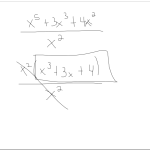
x^5 +3x^3 + 4x^2 / x^2
Student
is that right?
Tutor
perfect ! :D
Student
Sweet. I am starting to understand them I think
how about division by a polynomial?
Tutor
ok lets try this one
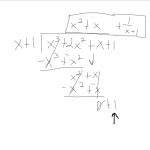
x^3+2x^2 +x+1 / x+1
perfect :D
right !
and you have a remainder
Student
not for this one right?
oh yes I do
Tutor
mmm let me check something
oh thats right :)
because you erased the 1 now , that was confusing me :)
now its perfect !
Student
hmmmm. lets try one like that again that comes out with a remainder. I got a little iffy there at the end
Sweet
can we try another one that will come out with a remainder?
Tutor
ok
let me think another example
ok
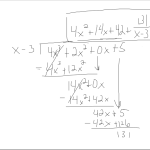
4x^3 + 2x^2 + 5 / x-3
Student
How does that look?
Tutor
lets check that :)
dont forget the 5 :)
Student
ummm ok, lets back up. I’m confused
Tutor
sure
up to that step its perfect :D
Student
so in order to get 14x^2 I must multiply by 14x
Tutor
right
Student
now I switch the signs and add
Tutor
wait
we are doing 42x +5
we cannot add something with an X to something without an X , right ?
Student
oh, it just came to me…I needed a place holder
Tutor
right hehe
Student
may we start this over again
tricky little devil
:-)
Tutor
sure :)
Student
Thank you for throwing that in because I had forgotten all about that
Tutor
ok , lets start again :)
perfect !
wait please
how did the 5 transformed into 126 ?
oh sorry
Student
so in order to get 42x I must multiply by 42
Tutor
because of the 42 :)
yeah i missed that , sorry :)
continue please
Student
no problem
does that look right now?
Tutor
yes it does :)
its perfect :D
Student
OK, great
so I need to remember to watch out for the exponents
and use a place holder whenever needed
Tutor
right :D
do you have any questions about what we have covered today ?
Student
I think I am good for now. I need to practice a little more but I am starting to grasp this. Thank you so much for the help.
Have a nice evening!
Tutor
your welcome :)
Colaborador: Javier Verde, Tutor Argentino de Álgebra
The post División de Polinomios first appeared on LatinHire Online Tutoring.
]]>Deprecated: explode(): Passing null to parameter #2 ($string) of type string is deprecated in /home/latinh2/dev.latinhire.com/wp-content/plugins/sitepress-multilingual-cms/inc/functions.php on line 506
Deprecated: explode(): Passing null to parameter #2 ($string) of type string is deprecated in /home/latinh2/dev.latinhire.com/wp-content/plugins/sitepress-multilingual-cms/inc/functions.php on line 506
Deprecated: explode(): Passing null to parameter #2 ($string) of type string is deprecated in /home/latinh2/dev.latinhire.com/wp-content/plugins/sitepress-multilingual-cms/inc/functions.php on line 506
Deprecated: explode(): Passing null to parameter #2 ($string) of type string is deprecated in /home/latinh2/dev.latinhire.com/wp-content/plugins/sitepress-multilingual-cms/inc/functions.php on line 506
https://dev.latinhire.com/es/cruzamientos-geneticos-y-prediccion-de-genotiposfenotipos/
Deprecated: Creation of dynamic property WP_Term::$cat_ID is deprecated in /home/latinh2/dev.latinhire.com/wp-includes/category.php on line 378
Deprecated: Creation of dynamic property WP_Term::$category_count is deprecated in /home/latinh2/dev.latinhire.com/wp-includes/category.php on line 379
Deprecated: Creation of dynamic property WP_Term::$category_description is deprecated in /home/latinh2/dev.latinhire.com/wp-includes/category.php on line 380
Deprecated: Creation of dynamic property WP_Term::$cat_name is deprecated in /home/latinh2/dev.latinhire.com/wp-includes/category.php on line 381
Deprecated: Creation of dynamic property WP_Term::$category_nicename is deprecated in /home/latinh2/dev.latinhire.com/wp-includes/category.php on line 382
Deprecated: Creation of dynamic property WP_Term::$category_parent is deprecated in /home/latinh2/dev.latinhire.com/wp-includes/category.php on line 383
La siguiente sesión muestra un/a estudiante que presenta un ejercicio típico sobre cruzamientos genéticos y predicción de genotipos y fenotipos. Aunque dice haber realizado la primera parte del ejercicio, opté por hacer una corrección de esta parte para asegurarme que los conocimientos teóricos y los métodos estuvieran claros. Fue aquí que descubrí un error…
The post Cruzamientos genéticos y predicción de genotipos/fenotipos first appeared on LatinHire Online Tutoring.
]]>Deprecated: explode(): Passing null to parameter #2 ($string) of type string is deprecated in /home/latinh2/dev.latinhire.com/wp-content/plugins/sitepress-multilingual-cms/inc/functions.php on line 506
Deprecated: explode(): Passing null to parameter #2 ($string) of type string is deprecated in /home/latinh2/dev.latinhire.com/wp-content/plugins/sitepress-multilingual-cms/inc/functions.php on line 506
Deprecated: explode(): Passing null to parameter #2 ($string) of type string is deprecated in /home/latinh2/dev.latinhire.com/wp-content/plugins/sitepress-multilingual-cms/inc/functions.php on line 506
Deprecated: explode(): Passing null to parameter #2 ($string) of type string is deprecated in /home/latinh2/dev.latinhire.com/wp-content/plugins/sitepress-multilingual-cms/inc/functions.php on line 506
Deprecated: explode(): Passing null to parameter #2 ($string) of type string is deprecated in /home/latinh2/dev.latinhire.com/wp-content/plugins/sitepress-multilingual-cms/inc/functions.php on line 506
Deprecated: explode(): Passing null to parameter #2 ($string) of type string is deprecated in /home/latinh2/dev.latinhire.com/wp-content/plugins/sitepress-multilingual-cms/inc/functions.php on line 506
Deprecated: explode(): Passing null to parameter #2 ($string) of type string is deprecated in /home/latinh2/dev.latinhire.com/wp-content/plugins/sitepress-multilingual-cms/inc/functions.php on line 506
Deprecated: explode(): Passing null to parameter #2 ($string) of type string is deprecated in /home/latinh2/dev.latinhire.com/wp-content/plugins/sitepress-multilingual-cms/inc/functions.php on line 506
Deprecated: explode(): Passing null to parameter #2 ($string) of type string is deprecated in /home/latinh2/dev.latinhire.com/wp-content/plugins/sitepress-multilingual-cms/inc/functions.php on line 506
Deprecated: explode(): Passing null to parameter #2 ($string) of type string is deprecated in /home/latinh2/dev.latinhire.com/wp-content/plugins/sitepress-multilingual-cms/inc/functions.php on line 506
Deprecated: explode(): Passing null to parameter #2 ($string) of type string is deprecated in /home/latinh2/dev.latinhire.com/wp-content/plugins/sitepress-multilingual-cms/inc/functions.php on line 506
Deprecated: explode(): Passing null to parameter #2 ($string) of type string is deprecated in /home/latinh2/dev.latinhire.com/wp-content/plugins/sitepress-multilingual-cms/inc/functions.php on line 506
Deprecated: explode(): Passing null to parameter #2 ($string) of type string is deprecated in /home/latinh2/dev.latinhire.com/wp-content/plugins/sitepress-multilingual-cms/inc/functions.php on line 506
Deprecated: explode(): Passing null to parameter #2 ($string) of type string is deprecated in /home/latinh2/dev.latinhire.com/wp-content/plugins/sitepress-multilingual-cms/inc/functions.php on line 506
Deprecated: explode(): Passing null to parameter #2 ($string) of type string is deprecated in /home/latinh2/dev.latinhire.com/wp-content/plugins/sitepress-multilingual-cms/inc/functions.php on line 506
Deprecated: explode(): Passing null to parameter #2 ($string) of type string is deprecated in /home/latinh2/dev.latinhire.com/wp-content/plugins/sitepress-multilingual-cms/inc/functions.php on line 506
Deprecated: explode(): Passing null to parameter #2 ($string) of type string is deprecated in /home/latinh2/dev.latinhire.com/wp-content/plugins/sitepress-multilingual-cms/inc/functions.php on line 506
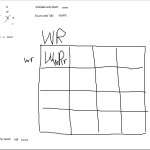
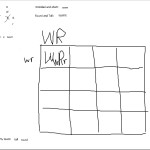
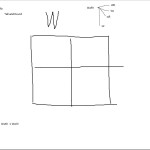
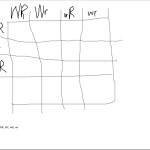
La siguiente sesión muestra un/a estudiante que presenta un ejercicio típico sobre cruzamientos genéticos y predicción de genotipos y fenotipos. Aunque dice haber realizado la primera parte del ejercicio, opté por hacer una corrección de esta parte para asegurarme que los conocimientos teóricos y los métodos estuvieran claros. Fue aquí que descubrí un error y recomenzamos el ejercicio para afianzar los conceptos esenciales del tema.
Student
Help. I don’t know how to do problem 2 & 3! I think I got the first one done already. 1) Cross a wrinkled-pea, short pea plant with a pure round-pea, tall pea plant. Work the cross on a Punnett square to obtain the F1 generation. Give genotypes ad phenotypes as ratios. (Round and tall are dominant traits. 2) Take any two of the offspring of the above cross (F1) and cross them to obtain the F2 generation. Work the cross on a Punnett square. 3) From the F2 Punnett square you did for the previous question, choose two individuals that will permit you to have a pure strain of winkled-pea, tall pea plants. *If you were looking at the phenotypes, would you be able to be sure you had chosen the correct plants to cross? *How would you know when you have obtained a pure strain of wrinkled-pea, tall pea plants?
Tutor
Welcome !
How are you?
Student
I’m fine but sorta struggling
Tutor
Don’t worry! We’ll work on this.
First of all, have you done the 1st part?
Student
I think so
Tutor
Ok, I need some information that is missing there.
There are 2 traits: wrinkle/pure and tall/short
Which is dominant in both?
Student
oh
sorry
Tutor
don’t worry :)
Student
round and tall are dominant
Tutor
I’m asking to check what you’ve done, to see if we can move to the 2nd directly
and how did you call the alleles?
which letter did you use for each one
Student
oh I used wrinkled for w
short for r
W for round
and R for Tall
Tutor
Ok, and how did you write the parental genotypes?
wrinkled and short
Student
wr
Tutor
That means that it has only one allele for each trait?
Student
round and tall is WR
Tutor
Each individual receives one allele from father and one from mother
right?
Student
umm oops
yeah
Tutor:)
how would you write the genotypes then?
The logic is the same, just writing the 2 alleles
wrinkle and short?
Student
wrinkled short-wwrr
Tutor
very good!
pure round and tall?
Student
round and tall: WWRR
Tutor
right, let’s assume that is PURE for both traits
that is, it’s homozygous for both
right?
Student
yeah
Tutor
Ok, can you do the crossing?
in the punnett square, as it asks in the exercise
Student
ok
Tutor
before you start…
oh ok
you did it right
Perfect!
Student
and the rest is the same…
Tutor
very good
how is this phenotype?
remember which is dominant over the other…
Student
it’s the round…
Tutor
good…
height?
tall or short?
Student
short…
Tutor
it’s Rr
Student
i mean tall
Tutor
right :)
So there you have the F1.
The 1st part of the exercise.
Luckily we checked it because if not, there were going to be mistakes
in the next part
We have time to do the 2nd part now
Student
ok
Tutor
Take any two of the offspring of the above cross (F1) and cross them to obtain the F2 generation. Work the cross on a Punnett square.
You got the first, I’m sure you can do this, want to try?
Student
ummm ok?
Tutor
We still have 5 minutes. After that we will have to round up the session, ok?
Student
okType your message here.
i dont get it
sorry
Tutor
DOn’t worry
Let’s see…
Second part
ask you to cross to individuals from the F1
We only have one type right?
So we’ll cross 2 «WwRr»
Student
yeah…
Tutor
which combinations of alleles can this individual give?
Student
ummm
WW, ww, RR, and rr?
Tutor
mmm…it has to be one allele for 1 trait and 1 for the other
It has to mix: one allele for height and one for texture
Student
WW, Ww, WR, and Wr?
Tutor
Why? WW ?
these are 2 alleles for the same trait
do you agree?
Student
oh ok
Tutor
From the genotype:
you take: one allele for the first trait ( W or w) and one for the other (R or r)
The gametes will have half the genotype of the individual
Student
ohhhh
Tutor
and always have alleles for every trait :)
Student
ok
Tutor
so, which are the possible combinations?
Student
Wr, wr, WR,
Tutor
right!
Student
sorry
Tutor
one’s missing
Student
Rw?
Tutor
right
so, both individuals will give these 4 combinations
Student
ok
Tutor
and now…the punnett square!
Ok, fill this.
Oe we finish with this, we’ll round up the session.
Student
ok
wait so do i cross those with those with WwRr?
Tutor
right
but both parents are the same
so the combinations are the same
you have to write the same on both sides of the square
Student
ok…
Tutor
The combinations given by each one are the same :)
Student
am i wrong?
Tutor
not at all
It’s perfect
Now, the typical crossing.
Want to do it now?
Or you think you can finish with this?
Student
ummm… I think i can finish this myself
Tutor
Oh ok:)
Probably you can finish this and the sign back again, to check this and finish the last question, ok?
Student
ok
thank you
Tutor
You’re welcome!
Good job!
Student
ok bye
Colaboradora: Nicole Rosenstock, Tutora Uruguaya de Biología
The post Cruzamientos genéticos y predicción de genotipos/fenotipos first appeared on LatinHire Online Tutoring.
]]>Deprecated: explode(): Passing null to parameter #2 ($string) of type string is deprecated in /home/latinh2/dev.latinhire.com/wp-content/plugins/sitepress-multilingual-cms/inc/functions.php on line 506
Deprecated: explode(): Passing null to parameter #2 ($string) of type string is deprecated in /home/latinh2/dev.latinhire.com/wp-content/plugins/sitepress-multilingual-cms/inc/functions.php on line 506
Deprecated: explode(): Passing null to parameter #2 ($string) of type string is deprecated in /home/latinh2/dev.latinhire.com/wp-content/plugins/sitepress-multilingual-cms/inc/functions.php on line 506
Deprecated: explode(): Passing null to parameter #2 ($string) of type string is deprecated in /home/latinh2/dev.latinhire.com/wp-content/plugins/sitepress-multilingual-cms/inc/functions.php on line 506
https://dev.latinhire.com/es/guiando-al-estudiante-en-la-compresion-de-consignas/
Deprecated: Creation of dynamic property WP_Term::$cat_ID is deprecated in /home/latinh2/dev.latinhire.com/wp-includes/category.php on line 378
Deprecated: Creation of dynamic property WP_Term::$category_count is deprecated in /home/latinh2/dev.latinhire.com/wp-includes/category.php on line 379
Deprecated: Creation of dynamic property WP_Term::$category_description is deprecated in /home/latinh2/dev.latinhire.com/wp-includes/category.php on line 380
Deprecated: Creation of dynamic property WP_Term::$cat_name is deprecated in /home/latinh2/dev.latinhire.com/wp-includes/category.php on line 381
Deprecated: Creation of dynamic property WP_Term::$category_nicename is deprecated in /home/latinh2/dev.latinhire.com/wp-includes/category.php on line 382
Deprecated: Creation of dynamic property WP_Term::$category_parent is deprecated in /home/latinh2/dev.latinhire.com/wp-includes/category.php on line 383
En las sesiones de Social Studies -fundamentalmente las que abordan temas históricos, religiosos, filosóficos o psicológicos-nos encontramos a menudo con que los estudiantes deben completar cuadros comparativos o descriptivos. En tal sentido, es esencial que puedan comprender el contenido de los textos que utilizan para establecer relaciones conceptuales y organizar la información. Como primer…
The post Guiando al estudiante en la compresión de consignas first appeared on LatinHire Online Tutoring.
]]>Deprecated: explode(): Passing null to parameter #2 ($string) of type string is deprecated in /home/latinh2/dev.latinhire.com/wp-content/plugins/sitepress-multilingual-cms/inc/functions.php on line 506

En las sesiones de Social Studies -fundamentalmente las que abordan temas históricos, religiosos, filosóficos o psicológicos-nos encontramos a menudo con que los estudiantes deben completar cuadros comparativos o descriptivos. En tal sentido, es esencial que puedan comprender el contenido de los textos que utilizan para establecer relaciones conceptuales y organizar la información.
Como primer paso es importante preguntar si están utilizando algún texto determinado (libro, apuntes, etc..). De no ser así, facilitaremos un Website de confianza (.edu preferentemente) para ir trabajando con los conceptos más relevantes. A continuación formularemos preguntas conductoras para confirmar la comprensión y guiaremos al estudiante para establecer relaciones conceptuales y organizar la información.
La pizarra que adjunto como muestra ha sido editada en función de los temas que fueron trabajados durante la sesión.
Colaborador: Jessica Bandista, Tutora Argentina de Social Studies
The post Guiando al estudiante en la compresión de consignas first appeared on LatinHire Online Tutoring.
]]>Deprecated: explode(): Passing null to parameter #2 ($string) of type string is deprecated in /home/latinh2/dev.latinhire.com/wp-content/plugins/sitepress-multilingual-cms/inc/functions.php on line 506
Deprecated: explode(): Passing null to parameter #2 ($string) of type string is deprecated in /home/latinh2/dev.latinhire.com/wp-content/plugins/sitepress-multilingual-cms/inc/functions.php on line 506
Deprecated: explode(): Passing null to parameter #2 ($string) of type string is deprecated in /home/latinh2/dev.latinhire.com/wp-content/plugins/sitepress-multilingual-cms/inc/functions.php on line 506
Deprecated: explode(): Passing null to parameter #2 ($string) of type string is deprecated in /home/latinh2/dev.latinhire.com/wp-content/plugins/sitepress-multilingual-cms/inc/functions.php on line 506
https://dev.latinhire.com/es/calculos-de-entalpias-por-cambios-de-temperatura-y-estado/
Student’s question: If delta Hvap of water is 40.7 kJ/mol, how much heat is needed to vaporize 25 g. of water? q=n*delta(Hvap)=56.5? —— I got this step. I just don’t know what to do for the next problem. Repeat for T(initial)=70 degrees C ¿Cómo deberíamos empezar la sesión? – La pregunta inicial del estudiante deja…
The post Cálculos de entalpías por cambios de temperatura y estado first appeared on LatinHire Online Tutoring.
]]>Deprecated: explode(): Passing null to parameter #2 ($string) of type string is deprecated in /home/latinh2/dev.latinhire.com/wp-content/plugins/sitepress-multilingual-cms/inc/functions.php on line 506
¿Cómo deberíamos empezar la sesión? – La pregunta inicial del estudiante deja ver que ya él ha hecho parte del trabajo y desea revisar si su trabajo es correcto para continuar con el siguiente ejercicio.
Tutor: Hi! How are you today?
Student: Good.
Tutor: Alright, let’s see your question.For the first part, you got it right.
What you think it should be the unit for 56.5?
If it’s heat.
Es importante nunca hacer pregunta sueltas, sino darle una indicación indirecta al estudiante de cómo podría saber la respuesta. El método intuitivo hace que el estudiante se sienta más seguro y comprenda mejor el concepto.
Student: kJ
Tutor: Excellent.
Now, let’s see the second part.
The calculation you did is valid when we have liquid water at 100ºC.
Student: I don’t know what to do because we don’t know the value of c and we don’t have the final temperature of t to find delta t.
Tutor: Alright, then let’s see what’s the process.
We start with water at 70ºC, right?
Student: Yes.
Tutor: If we want to vaporize it, we need to heat to the boiling point, right?
Student: Yes.
Tutor: Good.
Now that we reach the boiling point, we can vaporize it.
While water is vaporized, there is no change in temperature.
At the end we will get vapor at 100ºC.

Student: Oh I get it!
So delta T would be 30 C.
Tutor: Exactly!
En este punto, el principal propósito del tutor es hacer que el estudiante comprenda el concepto básico asociado al problema y que sea el estudiante quien deduzca la información.
Student: But you have to change it to Kelvin, right?
Tutor: Well, since we are making a delta, there’s no need to do it.
Student: Okay.
How do we find C?
Tutor: It’s given in books or tables.
It only depends on the substance.
Student: Oh!
Tutor: The value for water is 4.18J/g ºC.
Constantes y valores de la literatura pueden ser dados al estudiante. También puede dársele al estudiante fuentes de internet donde puede consultar fácilmente la información.
Student: Okay. So then you multiply 4.18, 30, and 25.
Tutor: Exactly!
Student: Okay, then why do you have to add it to n*delta(Hvap)?
Tutor: Because the process requires both steps.
Heating water and vaporizing it.
Student: Okay.
Tutor: However, what would be the unit we get for heat?
Student: J.
Tutor: Exactly!
Student: Why are they different?
Tutor: Because the value for C is given in J.
And Hvap in KJ.
We need to convert one of them.
Student: Yeah, but it doesn’t matter which one you leave it in?
Tutor: Not really.
Student: Okay.
Tutor: Do you prefer to convert to J or kJ?
Student: J.
Tutor: Alright.
Student: I got the answer.
I had another problem that I didn’t get.
Tutor: Alright.
Let’s check it.
Aunque es bueno verificar el trabajo del estudiante, muchos de ellos muestran una excelente comprensión del tema. Cuando el tutor lo crea conveniente, se debe revisar o no lo que el estudiante obtiene como respuesta, dependiendo de su comportamiento durante la sesión.
Student: Total q needed to raise T of 20 g ice from -10C to steam at 110C.
Hfus=6.009 kj/mol.
Hvap=40.79 kj/mol.
Cice=2.1 J/g*C.
Csteam=2.08 J/g*C.
Tutor: Alright, any ideas about this one?
Student: Not really.
Tutor: It’s okay.
It’s a bit similar to the former problem.
We start with solid ice at -10ºC.
So, we first need to heat ‘til the melting point, correct?
Student: Yeah.
Tutor: Good.
Student: 100.
Tutor: Let’s notice that’s the boiling point.
The melting point is 0ºC.
Student: Oh, right!
Tutor: So, the next step should be melting ice into liquid water, right?
Student: Yeah.
Tutor: What you think it should be the next process?
Student: Liquid to vapor.
Tutor: But first, getting water at 100ºC.
Since we want to vaporize.
Does it make sense?
Student: Yeah.
Tutor: Good.
Now we can go to vapor, as you mentioned.
Do you think there would be any additional step?
Student: 110ºC.
Would still be vapor?
Tutor: Exactly!
So we heat it.
Each line means we need to calculate a heat.
Student: Okay.

Es importante hacerle un bosquejo de la solución al estudiante cuando éste no está seguro de cómo proceder, así él sabrá qué pasos se seguirán.
Tutor: Any ideas how we can calculate heat number 1?
Student: q=m(c)(delta T).
Tutor: Exactly.
What would be the values?
Student: n would be 20/18.
Delta t would be 10.
What about C?
Tutor: Let’s notice they give C ice.
And it’s given in J/g ºC, so there’s no really need to convert to moles.
We can use grams.
Student: 2.1
Tutor: Right.
Student: Then for line 2, what is the value for C?
Tutor: Let’s notice the horizontal lines are changes of states.
Changes of states don’t use C.
But deltaH.
Student: Oh is that where you use n* delta h?
Tutor: Exactly!
Student: For line 1, I was multiplying the numbers together and I got 23.333, but my teacher got 420 J.
Tutor: Again, remember we don’t need to make 20/18.
C is given in grams.
So, we don’t convert to moles.
It would be just 20 times 2.1 times 10.
Student: Oh, I get it!
Tutor: Great!
Any questions for heat 2?
Student: That would be 20/18*6.009
Tutor: Exactly!
The unit should be J or kJ?
Student: And line 3 would be 20*2.08*100?
kJ.
Tutor: Right.
Remember C for liquid water is 4.18.
Student: Then do you use Hvap for line 4?
Tutor: Exactly.
Student: And line 5, you would use Csteam?
Tutor: Perfect, that’s correct!
Student: Okay. Thank you!
Tutor: No problem
Do you want to check the calculation or do you prefer to do it on your own?
Student: It’s okay. I have the answer because my teacher did. I just didn’t get it when she was explaining…
Tutor: Oh, alright!
Student: *did the problem.
Tutor: Do you have any questions about anything we went over today?
Student: No. I understood it.
Tutor: Great!
Have a nice night!
Student: You too!
Tutor:
Es importante estar seguro de que el estudiante comprendió completamente la solución y puede ahora resolver un problema del mismo tipo por su cuenta.
Colaborador: Alejandro Palacios, Tutor Colombiano de Química
The post Cálculos de entalpías por cambios de temperatura y estado first appeared on LatinHire Online Tutoring.
]]>Deprecated: explode(): Passing null to parameter #2 ($string) of type string is deprecated in /home/latinh2/dev.latinhire.com/wp-content/plugins/sitepress-multilingual-cms/inc/functions.php on line 506
Deprecated: explode(): Passing null to parameter #2 ($string) of type string is deprecated in /home/latinh2/dev.latinhire.com/wp-content/plugins/sitepress-multilingual-cms/inc/functions.php on line 506
Deprecated: explode(): Passing null to parameter #2 ($string) of type string is deprecated in /home/latinh2/dev.latinhire.com/wp-content/plugins/sitepress-multilingual-cms/inc/functions.php on line 506
Deprecated: explode(): Passing null to parameter #2 ($string) of type string is deprecated in /home/latinh2/dev.latinhire.com/wp-content/plugins/sitepress-multilingual-cms/inc/functions.php on line 506
https://dev.latinhire.com/es/funciones-trigonometricas-tutoria-online-completa-con-estudiante/
Deprecated: Creation of dynamic property WP_Term::$cat_ID is deprecated in /home/latinh2/dev.latinhire.com/wp-includes/category.php on line 378
Deprecated: Creation of dynamic property WP_Term::$category_count is deprecated in /home/latinh2/dev.latinhire.com/wp-includes/category.php on line 379
Deprecated: Creation of dynamic property WP_Term::$category_description is deprecated in /home/latinh2/dev.latinhire.com/wp-includes/category.php on line 380
Deprecated: Creation of dynamic property WP_Term::$cat_name is deprecated in /home/latinh2/dev.latinhire.com/wp-includes/category.php on line 381
Deprecated: Creation of dynamic property WP_Term::$category_nicename is deprecated in /home/latinh2/dev.latinhire.com/wp-includes/category.php on line 382
Deprecated: Creation of dynamic property WP_Term::$category_parent is deprecated in /home/latinh2/dev.latinhire.com/wp-includes/category.php on line 383
Comentarios del Tutor: Elegí esta sesión dado que , a diferencia de la manera en que resolvemos este tipo de problemas en algunas partes de Sudamérica , en EEUU optan por hacerlo utilizando esta «regla» en lugar de emplear la identidad trigonométrica Pitagórica. Además, se utilizan los recursos que se nos sugieren constantemente, chequeo de entendimiento. Un…
The post Funciones Trigonométricas: Tutoría Online completa con estudiante first appeared on LatinHire Online Tutoring.
]]>Deprecated: explode(): Passing null to parameter #2 ($string) of type string is deprecated in /home/latinh2/dev.latinhire.com/wp-content/plugins/sitepress-multilingual-cms/inc/functions.php on line 506

Comentarios del Tutor: Elegí esta sesión dado que , a diferencia de la manera en que resolvemos este tipo de problemas en algunas partes de Sudamérica , en EEUU optan por hacerlo utilizando esta «regla» en lugar de emplear la identidad trigonométrica Pitagórica. Además, se utilizan los recursos que se nos sugieren constantemente, chequeo de entendimiento. Un cierre de las sesión adecuado.
Student sec A = -4 , cot B =2/3 with A in QII and B in QIII. Find: Sin 2A cos(A-B) tan B/2 csc A/2
Tutor Welcome! How are you today?
Student im ok. Frustrated
Tutor oh, wellIll help you with this
Student thank you!
Tutor Any ideas about it?
Student I know I will need to use a few different Identities. But im not sure how to find Sin andCos to make them work
Tutor okay , first of all we need to get sin and cos for each angle
let’s think about angle A
Student yes , 1/cos
Tutor right, So how much is cos?
Student -4x?
Tutor we know sec is -4 and you told me sec is 1/cos
so how much is cos?
Student right
Tutor if you have sec you flip it , and you get cos
Student -1/4
Tutor perfect! Now we will use a triangle to get sin
Student i cant believe I didnt get that
Tutor we know cos is adj/hyp right?
Student yes
Tutor so we place the 1 and the 4 , like this…
How can we get the missing side?
Student then solve for b
Tutor yes, how much is it?
great! So how much is sin?
perfect!
Student where did the neg go from cos A
Tutor now we should work on angle B?
sec was negative and we also know the angle is in quad II is negative there
Student oh okay, but we dont nee that on the triangle?
Tutor nope its the same
Student oky
Tutor just think about the quadrant
Student ok
Tutor what about B? Ideas?
Student cot = cos/sin
Tutor right
Student so would cos be 2 and sin be 3?
Tutor [09:43] not exactly you should place the values in the triangle
Student [09:54] ok
Tutor and get the hypotenuse
great!
so , how much is sin B? and cos B?
can we leave a root in the denominator?
Student nope
Tutor so?
great!
let me tell you something angle B, Its in quadrant III, what do we know about the sin and cos values in q III?
Student cos is neg and so is sin
Tutor [15:49] okay, so we place the neg sign for them, now we can get the asked values
Student sin (A+A) is SinAcosA+CosAsinA
Tutor okay , you can plug the values
Student do i include teh negative here?
Tutor yes! How much is that?
Student do they cancel out?
Tutor both are negative
hmmm, you cant do that , you must combine both then you can reduce
Student oh!
Tutor perfect!
Student ok thx
Tutor now let me tell you something we forgot about angle B
Student ok
Tutor its in quadrant III , so what do we know about sin and cos?
Student cos is neg
Tutor and sin?
Student and so is sin
Tutor so we place the neg sign for them
Student i will try the others on my own and log back on if I cannot figure it out
Tutor oh ok great idea!
Student thank you
Tutor Thank you for using our service
Please, do me the favour of completing the survey and comment before leaving
Student yup
Tutor Have a great day! Bye bye
Student bye
Colaborador: Juan Belluscio, Tutor Argentino de Trigonometría
The post Funciones Trigonométricas: Tutoría Online completa con estudiante first appeared on LatinHire Online Tutoring.
]]>Deprecated: explode(): Passing null to parameter #2 ($string) of type string is deprecated in /home/latinh2/dev.latinhire.com/wp-content/plugins/sitepress-multilingual-cms/inc/functions.php on line 506
Deprecated: explode(): Passing null to parameter #2 ($string) of type string is deprecated in /home/latinh2/dev.latinhire.com/wp-content/plugins/sitepress-multilingual-cms/inc/functions.php on line 506
Deprecated: explode(): Passing null to parameter #2 ($string) of type string is deprecated in /home/latinh2/dev.latinhire.com/wp-content/plugins/sitepress-multilingual-cms/inc/functions.php on line 506
Deprecated: explode(): Passing null to parameter #2 ($string) of type string is deprecated in /home/latinh2/dev.latinhire.com/wp-content/plugins/sitepress-multilingual-cms/inc/functions.php on line 506
https://dev.latinhire.com/es/funciones-compuestas/
Student I’m working on composite functions, but do not understand what the «domain» is or how to find it. I can work through the problem, but am lost when it comes to the domain. Please help! (Tutor) Hi, my name is Juan. How are you today? Student I’m well. How are you? (Tutor) I’m good…
The post Funciones compuestas first appeared on LatinHire Online Tutoring.
]]>Deprecated: explode(): Passing null to parameter #2 ($string) of type string is deprecated in /home/latinh2/dev.latinhire.com/wp-content/plugins/sitepress-multilingual-cms/inc/functions.php on line 506

Student I’m working on composite functions, but do not understand what the «domain» is or how to find it. I can work through the problem, but am lost when it comes to the domain. Please help!
(Tutor) Hi, my name is Juan. How are you today?
Student I’m well. How are you?
(Tutor) I’m good :D, ok let’s get started!
Student ok. I’m needing to understand, what the «domain» is and how to find it?
(Tutor) Sure!
the domain is all the values that «x» can take
for example
let’s find the domain of f(x)
f(x)=4x+1
in that case does x have any restriction?
I mean is there an x value that we can’t use?
Student no. I don’t think so
(Tutor) correct
so the domain of that function is all real numbers
for example
this function
is there an x value that we can’t use?
Student 0
(Tutor) You got it!
Student ok
(Tutor) so the domain of this function is
all real numbers except zero
is it more clear?
or not?
should I try to explain it in a different way?
Student yes.. domain is all values that x can be for the given function
(Tutor) correct! :D
Student ok
(Tutor) let’s go back to the problem
Student ok
(Tutor) in this case
the domain of f(x) is all real numbers
how about g(x)?
Student I think i’m still slightly confused.
(Tutor) in that function
is there any x value that we can’t use?
Student no, i don’t think so
(Tutor) Correct
Student ok
(Tutor) so the domain is all real numbers
Student yes
(Tutor) Clue: the domain of a polynomial is always all real numbers
f(x) and g(x) are polynomials
Student ok. i see
(Tutor) so the domain will be all real numbers
and how about (fog)(x)
Student f(g(x))
(Tutor) correct :D
but they are asking for gof
Student yes
(Tutor) ok do you know how to find it?
Student g(4x+1)
(Tutor) yeah!
then
we have to use g
how would it be?
do you need help?
Student i think i’ve got it. I had trouble with the buttons
(Tutor) ohhh
what are you trying to do?
Student 2(4x +1)squared + 5(4x+1)
(Tutor) yeah!
Student 2(16x 2 + 8x + 1) + 20x + 5
32x 2 + 16x + 2 + 20 + 5
(Tutor) it is 20x
but well done!
Student equals 32x 2 + 36x +7
(Tutor) :D
You got it!
And what’s the domain of that function?
I understand what you wrote
but it should be written
like…
Student right, negative on the left
Student Thank you so much for your help! :)
(Tutor) No problem! It was great to work with you!
Bye
Student thanks. Bye
Colaborador: Juan Cruz, Tutor Colombiano de Álgebra
The post Funciones compuestas first appeared on LatinHire Online Tutoring.
]]>