Deprecated: explode(): Passing null to parameter #2 ($string) of type string is deprecated in /home/latinh2/dev.latinhire.com/wp-content/plugins/sitepress-multilingual-cms/inc/functions.php on line 506
Deprecated: explode(): Passing null to parameter #2 ($string) of type string is deprecated in /home/latinh2/dev.latinhire.com/wp-content/plugins/sitepress-multilingual-cms/inc/functions.php on line 506
Deprecated: explode(): Passing null to parameter #2 ($string) of type string is deprecated in /home/latinh2/dev.latinhire.com/wp-content/plugins/sitepress-multilingual-cms/inc/functions.php on line 506
Deprecated: explode(): Passing null to parameter #2 ($string) of type string is deprecated in /home/latinh2/dev.latinhire.com/wp-content/plugins/sitepress-multilingual-cms/inc/functions.php on line 506
https://dev.latinhire.com/es/division-de-polinomios/
Deprecated: Creation of dynamic property WP_Term::$cat_ID is deprecated in /home/latinh2/dev.latinhire.com/wp-includes/category.php on line 378
Deprecated: Creation of dynamic property WP_Term::$category_count is deprecated in /home/latinh2/dev.latinhire.com/wp-includes/category.php on line 379
Deprecated: Creation of dynamic property WP_Term::$category_description is deprecated in /home/latinh2/dev.latinhire.com/wp-includes/category.php on line 380
Deprecated: Creation of dynamic property WP_Term::$cat_name is deprecated in /home/latinh2/dev.latinhire.com/wp-includes/category.php on line 381
Deprecated: Creation of dynamic property WP_Term::$category_nicename is deprecated in /home/latinh2/dev.latinhire.com/wp-includes/category.php on line 382
Deprecated: Creation of dynamic property WP_Term::$category_parent is deprecated in /home/latinh2/dev.latinhire.com/wp-includes/category.php on line 383
Deprecated: Creation of dynamic property WP_Term::$cat_ID is deprecated in /home/latinh2/dev.latinhire.com/wp-includes/category.php on line 378
Deprecated: Creation of dynamic property WP_Term::$category_count is deprecated in /home/latinh2/dev.latinhire.com/wp-includes/category.php on line 379
Deprecated: Creation of dynamic property WP_Term::$category_description is deprecated in /home/latinh2/dev.latinhire.com/wp-includes/category.php on line 380
Deprecated: Creation of dynamic property WP_Term::$cat_name is deprecated in /home/latinh2/dev.latinhire.com/wp-includes/category.php on line 381
Deprecated: Creation of dynamic property WP_Term::$category_nicename is deprecated in /home/latinh2/dev.latinhire.com/wp-includes/category.php on line 382
Deprecated: Creation of dynamic property WP_Term::$category_parent is deprecated in /home/latinh2/dev.latinhire.com/wp-includes/category.php on line 383
Deprecated: explode(): Passing null to parameter #2 ($string) of type string is deprecated in /home/latinh2/dev.latinhire.com/wp-content/plugins/sitepress-multilingual-cms/inc/functions.php on line 506
Deprecated: Constant FILTER_SANITIZE_STRING is deprecated in /home/latinh2/dev.latinhire.com/wp-content/plugins/sitepress-multilingual-cms/classes/request-handling/class-wpml-rest-request-analyze.php on line 61
Deprecated: explode(): Passing null to parameter #2 ($string) of type string is deprecated in /home/latinh2/dev.latinhire.com/wp-content/plugins/sitepress-multilingual-cms/inc/functions.php on line 506
Deprecated: explode(): Passing null to parameter #2 ($string) of type string is deprecated in /home/latinh2/dev.latinhire.com/wp-content/plugins/sitepress-multilingual-cms/inc/functions.php on line 506
Deprecated: preg_replace(): Passing null to parameter #3 ($subject) of type array|string is deprecated in /home/latinh2/dev.latinhire.com/wp-content/plugins/all-in-one-seo-pack-pro/app/Common/Traits/Helpers/Strings.php on line 158
Comentario del Tutor: Elegí esta sesión ya que abarca un tema que no es muy usual de ver en Argentina , división de polinomios , por otro lado , en esta sesión el alumno no tenia un problema puntual para resolver , sino que necesitaba practica, esto no es muy común , ya que normalmente los alumnos nos…
The post División de Polinomios first appeared on LatinHire Online Tutoring.
]]>Deprecated: explode(): Passing null to parameter #2 ($string) of type string is deprecated in /home/latinh2/dev.latinhire.com/wp-content/plugins/sitepress-multilingual-cms/inc/functions.php on line 506
Deprecated: explode(): Passing null to parameter #2 ($string) of type string is deprecated in /home/latinh2/dev.latinhire.com/wp-content/plugins/sitepress-multilingual-cms/inc/functions.php on line 506
Deprecated: explode(): Passing null to parameter #2 ($string) of type string is deprecated in /home/latinh2/dev.latinhire.com/wp-content/plugins/sitepress-multilingual-cms/inc/functions.php on line 506
Deprecated: explode(): Passing null to parameter #2 ($string) of type string is deprecated in /home/latinh2/dev.latinhire.com/wp-content/plugins/sitepress-multilingual-cms/inc/functions.php on line 506
Deprecated: explode(): Passing null to parameter #2 ($string) of type string is deprecated in /home/latinh2/dev.latinhire.com/wp-content/plugins/sitepress-multilingual-cms/inc/functions.php on line 506
Deprecated: explode(): Passing null to parameter #2 ($string) of type string is deprecated in /home/latinh2/dev.latinhire.com/wp-content/plugins/sitepress-multilingual-cms/inc/functions.php on line 506
Deprecated: explode(): Passing null to parameter #2 ($string) of type string is deprecated in /home/latinh2/dev.latinhire.com/wp-content/plugins/sitepress-multilingual-cms/inc/functions.php on line 506
Deprecated: explode(): Passing null to parameter #2 ($string) of type string is deprecated in /home/latinh2/dev.latinhire.com/wp-content/plugins/sitepress-multilingual-cms/inc/functions.php on line 506
Deprecated: explode(): Passing null to parameter #2 ($string) of type string is deprecated in /home/latinh2/dev.latinhire.com/wp-content/plugins/sitepress-multilingual-cms/inc/functions.php on line 506
Deprecated: explode(): Passing null to parameter #2 ($string) of type string is deprecated in /home/latinh2/dev.latinhire.com/wp-content/plugins/sitepress-multilingual-cms/inc/functions.php on line 506
Deprecated: explode(): Passing null to parameter #2 ($string) of type string is deprecated in /home/latinh2/dev.latinhire.com/wp-content/plugins/sitepress-multilingual-cms/inc/functions.php on line 506
Deprecated: explode(): Passing null to parameter #2 ($string) of type string is deprecated in /home/latinh2/dev.latinhire.com/wp-content/plugins/sitepress-multilingual-cms/inc/functions.php on line 506
Deprecated: explode(): Passing null to parameter #2 ($string) of type string is deprecated in /home/latinh2/dev.latinhire.com/wp-content/plugins/sitepress-multilingual-cms/inc/functions.php on line 506
Deprecated: explode(): Passing null to parameter #2 ($string) of type string is deprecated in /home/latinh2/dev.latinhire.com/wp-content/plugins/sitepress-multilingual-cms/inc/functions.php on line 506
Deprecated: explode(): Passing null to parameter #2 ($string) of type string is deprecated in /home/latinh2/dev.latinhire.com/wp-content/plugins/sitepress-multilingual-cms/inc/functions.php on line 506
Deprecated: explode(): Passing null to parameter #2 ($string) of type string is deprecated in /home/latinh2/dev.latinhire.com/wp-content/plugins/sitepress-multilingual-cms/inc/functions.php on line 506
Deprecated: explode(): Passing null to parameter #2 ($string) of type string is deprecated in /home/latinh2/dev.latinhire.com/wp-content/plugins/sitepress-multilingual-cms/inc/functions.php on line 506
Comentario del Tutor: Elegí esta sesión ya que abarca un tema que no es muy usual de ver en Argentina , división de polinomios , por otro lado , en esta sesión el alumno no tenia un problema puntual para resolver , sino que necesitaba practica, esto no es muy común , ya que normalmente los alumnos nos piden ayuda para resolver problemas particulares, a su vez trae una complicación , ya que se debe proveer un ejercicio adecuado al nivel del alumno , ni muy básico ni muy elevado . Por eso mismo en esta sesión comenzamos con un ejercicio simple , para comprobar que el alumno tuviese los conocimientos básicos necesarios , y luego optamos por resolver uno mas complicado , logrando que el alumno se esfuerce para resolver el ejercicio.
Student
I need help understanding division of polynomial a by monomials and polynomials.
Tutor
Welcome to Tutor.com ! My name is Javier . How are you ?
Student
Hello Javier. I am great. How are you?
Tutor
Im fine , thanks for asking :)
Student
Can you give me an example of a polynomial divided by a monomial and I will give it a shot?
Tutor
sure
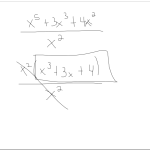
x^5 +3x^3 + 4x^2 / x^2
Student
is that right?
Tutor
perfect ! :D
Student
Sweet. I am starting to understand them I think
how about division by a polynomial?
Tutor
ok lets try this one
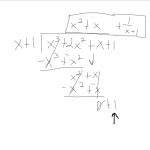
x^3+2x^2 +x+1 / x+1
perfect :D
right !
and you have a remainder
Student
not for this one right?
oh yes I do
Tutor
mmm let me check something
oh thats right :)
because you erased the 1 now , that was confusing me :)
now its perfect !
Student
hmmmm. lets try one like that again that comes out with a remainder. I got a little iffy there at the end
Sweet
can we try another one that will come out with a remainder?
Tutor
ok
let me think another example
ok
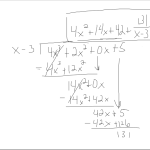
4x^3 + 2x^2 + 5 / x-3
Student
How does that look?
Tutor
lets check that :)
dont forget the 5 :)
Student
ummm ok, lets back up. I’m confused
Tutor
sure
up to that step its perfect :D
Student
so in order to get 14x^2 I must multiply by 14x
Tutor
right
Student
now I switch the signs and add
Tutor
wait
we are doing 42x +5
we cannot add something with an X to something without an X , right ?
Student
oh, it just came to me…I needed a place holder
Tutor
right hehe
Student
may we start this over again
tricky little devil
:-)
Tutor
sure :)
Student
Thank you for throwing that in because I had forgotten all about that
Tutor
ok , lets start again :)
perfect !
wait please
how did the 5 transformed into 126 ?
oh sorry
Student
so in order to get 42x I must multiply by 42
Tutor
because of the 42 :)
yeah i missed that , sorry :)
continue please
Student
no problem
does that look right now?
Tutor
yes it does :)
its perfect :D
Student
OK, great
so I need to remember to watch out for the exponents
and use a place holder whenever needed
Tutor
right :D
do you have any questions about what we have covered today ?
Student
I think I am good for now. I need to practice a little more but I am starting to grasp this. Thank you so much for the help.
Have a nice evening!
Tutor
your welcome :)
Colaborador: Javier Verde, Tutor Argentino de Álgebra
The post División de Polinomios first appeared on LatinHire Online Tutoring.
]]>Deprecated: explode(): Passing null to parameter #2 ($string) of type string is deprecated in /home/latinh2/dev.latinhire.com/wp-content/plugins/sitepress-multilingual-cms/inc/functions.php on line 506
Deprecated: explode(): Passing null to parameter #2 ($string) of type string is deprecated in /home/latinh2/dev.latinhire.com/wp-content/plugins/sitepress-multilingual-cms/inc/functions.php on line 506
Deprecated: explode(): Passing null to parameter #2 ($string) of type string is deprecated in /home/latinh2/dev.latinhire.com/wp-content/plugins/sitepress-multilingual-cms/inc/functions.php on line 506
Deprecated: explode(): Passing null to parameter #2 ($string) of type string is deprecated in /home/latinh2/dev.latinhire.com/wp-content/plugins/sitepress-multilingual-cms/inc/functions.php on line 506
https://dev.latinhire.com/es/funciones-compuestas/
Student I’m working on composite functions, but do not understand what the «domain» is or how to find it. I can work through the problem, but am lost when it comes to the domain. Please help! (Tutor) Hi, my name is Juan. How are you today? Student I’m well. How are you? (Tutor) I’m good…
The post Funciones compuestas first appeared on LatinHire Online Tutoring.
]]>Deprecated: explode(): Passing null to parameter #2 ($string) of type string is deprecated in /home/latinh2/dev.latinhire.com/wp-content/plugins/sitepress-multilingual-cms/inc/functions.php on line 506

Student I’m working on composite functions, but do not understand what the «domain» is or how to find it. I can work through the problem, but am lost when it comes to the domain. Please help!
(Tutor) Hi, my name is Juan. How are you today?
Student I’m well. How are you?
(Tutor) I’m good :D, ok let’s get started!
Student ok. I’m needing to understand, what the «domain» is and how to find it?
(Tutor) Sure!
the domain is all the values that «x» can take
for example
let’s find the domain of f(x)
f(x)=4x+1
in that case does x have any restriction?
I mean is there an x value that we can’t use?
Student no. I don’t think so
(Tutor) correct
so the domain of that function is all real numbers
for example
this function
is there an x value that we can’t use?
Student 0
(Tutor) You got it!
Student ok
(Tutor) so the domain of this function is
all real numbers except zero
is it more clear?
or not?
should I try to explain it in a different way?
Student yes.. domain is all values that x can be for the given function
(Tutor) correct! :D
Student ok
(Tutor) let’s go back to the problem
Student ok
(Tutor) in this case
the domain of f(x) is all real numbers
how about g(x)?
Student I think i’m still slightly confused.
(Tutor) in that function
is there any x value that we can’t use?
Student no, i don’t think so
(Tutor) Correct
Student ok
(Tutor) so the domain is all real numbers
Student yes
(Tutor) Clue: the domain of a polynomial is always all real numbers
f(x) and g(x) are polynomials
Student ok. i see
(Tutor) so the domain will be all real numbers
and how about (fog)(x)
Student f(g(x))
(Tutor) correct :D
but they are asking for gof
Student yes
(Tutor) ok do you know how to find it?
Student g(4x+1)
(Tutor) yeah!
then
we have to use g
how would it be?
do you need help?
Student i think i’ve got it. I had trouble with the buttons
(Tutor) ohhh
what are you trying to do?
Student 2(4x +1)squared + 5(4x+1)
(Tutor) yeah!
Student 2(16x 2 + 8x + 1) + 20x + 5
32x 2 + 16x + 2 + 20 + 5
(Tutor) it is 20x
but well done!
Student equals 32x 2 + 36x +7
(Tutor) :D
You got it!
And what’s the domain of that function?
I understand what you wrote
but it should be written
like…
Student right, negative on the left
Student Thank you so much for your help! :)
(Tutor) No problem! It was great to work with you!
Bye
Student thanks. Bye
Colaborador: Juan Cruz, Tutor Colombiano de Álgebra
The post Funciones compuestas first appeared on LatinHire Online Tutoring.
]]>Deprecated: explode(): Passing null to parameter #2 ($string) of type string is deprecated in /home/latinh2/dev.latinhire.com/wp-content/plugins/sitepress-multilingual-cms/inc/functions.php on line 506
Deprecated: explode(): Passing null to parameter #2 ($string) of type string is deprecated in /home/latinh2/dev.latinhire.com/wp-content/plugins/sitepress-multilingual-cms/inc/functions.php on line 506
Deprecated: explode(): Passing null to parameter #2 ($string) of type string is deprecated in /home/latinh2/dev.latinhire.com/wp-content/plugins/sitepress-multilingual-cms/inc/functions.php on line 506
Deprecated: explode(): Passing null to parameter #2 ($string) of type string is deprecated in /home/latinh2/dev.latinhire.com/wp-content/plugins/sitepress-multilingual-cms/inc/functions.php on line 506
https://dev.latinhire.com/es/utilizando-colores-para-los-ejemplos/
El uso de colores puede ayudar a los estudiantes a entender los ejemplos. Colaborador: Giovanny Espinal, Tutor Colombiano de Álgebra
The post Utilizando colores para los ejemplos first appeared on LatinHire Online Tutoring.
]]>Deprecated: explode(): Passing null to parameter #2 ($string) of type string is deprecated in /home/latinh2/dev.latinhire.com/wp-content/plugins/sitepress-multilingual-cms/inc/functions.php on line 506


Colaborador: Giovanny Espinal, Tutor Colombiano de Álgebra
The post Utilizando colores para los ejemplos first appeared on LatinHire Online Tutoring.
]]>Deprecated: explode(): Passing null to parameter #2 ($string) of type string is deprecated in /home/latinh2/dev.latinhire.com/wp-content/plugins/sitepress-multilingual-cms/inc/functions.php on line 506
Deprecated: explode(): Passing null to parameter #2 ($string) of type string is deprecated in /home/latinh2/dev.latinhire.com/wp-content/plugins/sitepress-multilingual-cms/inc/functions.php on line 506
Deprecated: explode(): Passing null to parameter #2 ($string) of type string is deprecated in /home/latinh2/dev.latinhire.com/wp-content/plugins/sitepress-multilingual-cms/inc/functions.php on line 506
Deprecated: explode(): Passing null to parameter #2 ($string) of type string is deprecated in /home/latinh2/dev.latinhire.com/wp-content/plugins/sitepress-multilingual-cms/inc/functions.php on line 506
https://dev.latinhire.com/es/conicas/
Círculo Center-radius form Donde (h , k) es el centro del círculo y R es el radio General Form Como cambiar de general form a center-radius form Suelen conocer este método como completar cuadrados. Para hallar el número necesario para completar cada cuadrado se utiliza la regla de dividir “b” por dos , y luego…
The post Cónicas first appeared on LatinHire Online Tutoring.
]]>Deprecated: explode(): Passing null to parameter #2 ($string) of type string is deprecated in /home/latinh2/dev.latinhire.com/wp-content/plugins/sitepress-multilingual-cms/inc/functions.php on line 506
Center-radius form

Donde (h , k) es el centro del círculo y R es el radio
General Form

Como cambiar de general form a center-radius form

Suelen conocer este método como completar cuadrados. Para hallar el número necesario para completar cada cuadrado se utiliza la regla de dividir “b” por dos , y luego elevarlo al cuadrado.
Siempre se suma en ambos lados para balancear la ecuación.
Elipse
Standard Form
Cuando el eje horizontal es mayor


Cuando el eje vertical es mayor


En ambas figuras la elipse esta centrada en el origen , denominamos al centro c= (h , k).
Es importante destacar que “a” siempre debe ser mayor que “b”. “a” Siempre esta relacionado con el eje mayor.
Los puntos verdes señalan los focos de la elipse, los cuales siempre están situados sobre el eje mayor.

La manera de hallar “c” es la misma para ambos tipos de elipse. Utilizando se, se pueden obtener las coordenadas de los focos.
Pasar de General Form a Standard Form

El método es bastante simple, el único detalle importante es recordar que a la hora de balancear, se debe tener en cuenta que los números añadidos están afectados por los números previamente factoreados, es por eso que del otro lado simplemente sumaremos 1 y 3.
Hipérbola
Standard Form
Eje focal Horizontal


Eje focal Vertical


En ambas figuras la hipérbola esta centrada en el origen, denominamos el centro C= (h,k). Los focos estan representados por los puntos verdes.

Parábola

La linea azul representa el eje de simetría de la parábola.
La linea verde representa la directriz de la parábola.
“p” representa la distancia del foco al vértice y también del vértice a la directriz.
Eje de simetría Vertical

Eje de simetría Horizontal

Ecuacion de las Asíntotas


The post Cónicas first appeared on LatinHire Online Tutoring.
]]>Deprecated: explode(): Passing null to parameter #2 ($string) of type string is deprecated in /home/latinh2/dev.latinhire.com/wp-content/plugins/sitepress-multilingual-cms/inc/functions.php on line 506
Deprecated: explode(): Passing null to parameter #2 ($string) of type string is deprecated in /home/latinh2/dev.latinhire.com/wp-content/plugins/sitepress-multilingual-cms/inc/functions.php on line 506
Deprecated: explode(): Passing null to parameter #2 ($string) of type string is deprecated in /home/latinh2/dev.latinhire.com/wp-content/plugins/sitepress-multilingual-cms/inc/functions.php on line 506
Deprecated: explode(): Passing null to parameter #2 ($string) of type string is deprecated in /home/latinh2/dev.latinhire.com/wp-content/plugins/sitepress-multilingual-cms/inc/functions.php on line 506
https://dev.latinhire.com/es/numero-de-zeros-regla-de-descartes/
Algunas veces tendremos que averiguar las posibles cantidades de “zeros” de un polinomio, sin averiguar cuales son estos. Para esto usaremos la regla de Descartes. Número de “Zeros” posibles Positivos Para obtenerla evaluaremos la cantidad de cambios de signo entre términos consecutivos. Podemos observar que hay 4 cambios de signo , por lo tanto tendremos…
The post Número de «Zeros». Regla de Descartes first appeared on LatinHire Online Tutoring.
]]>Deprecated: explode(): Passing null to parameter #2 ($string) of type string is deprecated in /home/latinh2/dev.latinhire.com/wp-content/plugins/sitepress-multilingual-cms/inc/functions.php on line 506
Número de “Zeros” posibles Positivos
Para obtenerla evaluaremos la cantidad de cambios de signo entre términos consecutivos.

Podemos observar que hay 4 cambios de signo , por lo tanto tendremos nuestras cantidades posibles de “zeros” positivos serán:
4 , 4-2 =2 , 2-2 =0. Por lo tanto tendremos 4 ,2 o 0 “zeros” positivos.
Siempre restaremos “2” hasta obtener 0 o 1, como regla para obtener las diferentes cantidades posibles.
Número de “Zeros” posibles Negativos
Para analizar la cantidad de “zeros” negativos utilizaremos f(-x) del polinomio. Luego realizaremos el mismo procedimiento.

Al haber un solo cambio de signo sabemos que hay un solo “zero” negativo. Tambien procederíamos a restar de 2 en 2 , pero aquí no podemos dado que comenzamos desde “1”.
The post Número de «Zeros». Regla de Descartes first appeared on LatinHire Online Tutoring.
]]>Deprecated: explode(): Passing null to parameter #2 ($string) of type string is deprecated in /home/latinh2/dev.latinhire.com/wp-content/plugins/sitepress-multilingual-cms/inc/functions.php on line 506
Deprecated: explode(): Passing null to parameter #2 ($string) of type string is deprecated in /home/latinh2/dev.latinhire.com/wp-content/plugins/sitepress-multilingual-cms/inc/functions.php on line 506
Deprecated: explode(): Passing null to parameter #2 ($string) of type string is deprecated in /home/latinh2/dev.latinhire.com/wp-content/plugins/sitepress-multilingual-cms/inc/functions.php on line 506
Deprecated: explode(): Passing null to parameter #2 ($string) of type string is deprecated in /home/latinh2/dev.latinhire.com/wp-content/plugins/sitepress-multilingual-cms/inc/functions.php on line 506
https://dev.latinhire.com/es/factorizacion/
Hago una breve mención de los casos de factoreo que más utilizan, junto con los respectivos nombres en inglés. Diferencia de cuadrados. Difference of perfect squares Diferencia de Cubos. Difference of Cubes Suma de Cubos. Sum of Cubes Trinomios perfectos y no perfectos. Trinomial Para los trinomios se utilizan algunas formas particulares de resolución, NUNCA…
The post Factorización first appeared on LatinHire Online Tutoring.
]]>Deprecated: explode(): Passing null to parameter #2 ($string) of type string is deprecated in /home/latinh2/dev.latinhire.com/wp-content/plugins/sitepress-multilingual-cms/inc/functions.php on line 506
Diferencia de cuadrados. Difference of perfect squares

Diferencia de Cubos. Difference of Cubes

Suma de Cubos. Sum of Cubes

Trinomios perfectos y no perfectos. Trinomial
Para los trinomios se utilizan algunas formas particulares de resolución, NUNCA utilizar la fórmula cuadrática para factorear un trinomio cuando las raíces son racionales.
Caso 1 : A=1

La idea es buscar dos números que multiplicados den -21 (c) y sumados den -4 (b).

Podemos pensar en -7 y 3, ya que:
(-7) 3 = -21
(-7) + 3 = -4

Con estos números completamos la factorizaciones.
Cross Method

En la cruz se colocaran “b” y “a x c “ (en rojo). Por lo que se buscaran dos números que sumados den -11 (b) y multiplicados den
-12( a x c).
Obtenemos los valores -12 y +1 ya que:
(-12 ) (+1) = -12
-12 + 1 = -11
Con eso separaremos -11x en -12x y +1x. Luego simplemente aplicaremos factor por grupos.
Box Method
El método es muy similar, también se utiliza la cruz, pero en vez de factorear por grupos a la manera clásica, empleamos la caja.

Se completa la caja como indica la figura y luego se factorea cada fila y cada columna. (indicado por las flechas)
Con los resultados de las filas y columnas factorizadas se puede reescribir el polinomio factorizado
The post Factorización first appeared on LatinHire Online Tutoring.
]]>Deprecated: explode(): Passing null to parameter #2 ($string) of type string is deprecated in /home/latinh2/dev.latinhire.com/wp-content/plugins/sitepress-multilingual-cms/inc/functions.php on line 506
Deprecated: explode(): Passing null to parameter #2 ($string) of type string is deprecated in /home/latinh2/dev.latinhire.com/wp-content/plugins/sitepress-multilingual-cms/inc/functions.php on line 506
Deprecated: explode(): Passing null to parameter #2 ($string) of type string is deprecated in /home/latinh2/dev.latinhire.com/wp-content/plugins/sitepress-multilingual-cms/inc/functions.php on line 506
Deprecated: explode(): Passing null to parameter #2 ($string) of type string is deprecated in /home/latinh2/dev.latinhire.com/wp-content/plugins/sitepress-multilingual-cms/inc/functions.php on line 506
https://dev.latinhire.com/es/resolucion-analitica-de-sistema-de-ecuaciones/
Comúnmente se manejan con dos sistemas de resolución de ecuaciones. Sustitución “Substitution” y Eliminación “Elimination”. La única diferencia con respecto a esto, es que en el sistema de eliminación, siempre eliminan una variable mediante la suma de ambas ecuaciones, nunca a través de la resta. Un ejemplo muy claro de esto es: Luego para obtener…
The post Resolución Analítica de Sistema de Ecuaciones first appeared on LatinHire Online Tutoring.
]]>Deprecated: explode(): Passing null to parameter #2 ($string) of type string is deprecated in /home/latinh2/dev.latinhire.com/wp-content/plugins/sitepress-multilingual-cms/inc/functions.php on line 506


Luego para obtener la otra variable simplemente se utiliza sustitución.
The post Resolución Analítica de Sistema de Ecuaciones first appeared on LatinHire Online Tutoring.
]]>Deprecated: explode(): Passing null to parameter #2 ($string) of type string is deprecated in /home/latinh2/dev.latinhire.com/wp-content/plugins/sitepress-multilingual-cms/inc/functions.php on line 506
Deprecated: explode(): Passing null to parameter #2 ($string) of type string is deprecated in /home/latinh2/dev.latinhire.com/wp-content/plugins/sitepress-multilingual-cms/inc/functions.php on line 506
Deprecated: explode(): Passing null to parameter #2 ($string) of type string is deprecated in /home/latinh2/dev.latinhire.com/wp-content/plugins/sitepress-multilingual-cms/inc/functions.php on line 506
Deprecated: explode(): Passing null to parameter #2 ($string) of type string is deprecated in /home/latinh2/dev.latinhire.com/wp-content/plugins/sitepress-multilingual-cms/inc/functions.php on line 506
https://dev.latinhire.com/es/como-reconstruir-un-polinomio/
Reconstruir un polinomio dadas las raíces suele ser algo simple, basta escribir la forma factorizada para luego aplicar propiedad distributiva y lograr la forma polinómica. La dificultad de estos ejercicios muchas veces recae en que se brinda tan solo una raíz imaginaria. Por ejemplo: Obtener un polinomio dadas las raíces, 1 y 1 – 3i.…
The post Cómo Reconstruir un Polinomio first appeared on LatinHire Online Tutoring.
]]>Deprecated: explode(): Passing null to parameter #2 ($string) of type string is deprecated in /home/latinh2/dev.latinhire.com/wp-content/plugins/sitepress-multilingual-cms/inc/functions.php on line 506
Por ejemplo:
Obtener un polinomio dadas las raíces, 1 y 1 – 3i.
La respuesta a esto es simple el teorema de las raíces imaginarias nos asegura que si “1 – 3i” es una raíz del polinomio también lo será el par conjugado “1+3i”, con esta raíz podremos aplicar distributiva y obtener la forma polinómica sin ningún problema.
The post Cómo Reconstruir un Polinomio first appeared on LatinHire Online Tutoring.
]]>Deprecated: explode(): Passing null to parameter #2 ($string) of type string is deprecated in /home/latinh2/dev.latinhire.com/wp-content/plugins/sitepress-multilingual-cms/inc/functions.php on line 506
Deprecated: explode(): Passing null to parameter #2 ($string) of type string is deprecated in /home/latinh2/dev.latinhire.com/wp-content/plugins/sitepress-multilingual-cms/inc/functions.php on line 506
Deprecated: explode(): Passing null to parameter #2 ($string) of type string is deprecated in /home/latinh2/dev.latinhire.com/wp-content/plugins/sitepress-multilingual-cms/inc/functions.php on line 506
Deprecated: explode(): Passing null to parameter #2 ($string) of type string is deprecated in /home/latinh2/dev.latinhire.com/wp-content/plugins/sitepress-multilingual-cms/inc/functions.php on line 506
https://dev.latinhire.com/es/end-behavior-crtiterios-para-determinar-como-lucira-el-grafico-de-un-polinomio/
Polinomios Pares “Even” (Mayor Grado Par) Coeficiente Principal Positivo Coeficiente Principal Negativo Polinomios Impares “Odd” (Mayor Grado Impar) Coeficiente Principal Positivo Coeficiente Principal Negativo
The post End Behavior: Crtiterios para determinar como lucirá el gráfico de un polinomio first appeared on LatinHire Online Tutoring.
]]>Deprecated: explode(): Passing null to parameter #2 ($string) of type string is deprecated in /home/latinh2/dev.latinhire.com/wp-content/plugins/sitepress-multilingual-cms/inc/functions.php on line 506
Coeficiente Principal Positivo


Coeficiente Principal Negativo


Polinomios Impares “Odd” (Mayor Grado Impar)
Coeficiente Principal Positivo


Coeficiente Principal Negativo


The post End Behavior: Crtiterios para determinar como lucirá el gráfico de un polinomio first appeared on LatinHire Online Tutoring.
]]>Deprecated: explode(): Passing null to parameter #2 ($string) of type string is deprecated in /home/latinh2/dev.latinhire.com/wp-content/plugins/sitepress-multilingual-cms/inc/functions.php on line 506
Deprecated: explode(): Passing null to parameter #2 ($string) of type string is deprecated in /home/latinh2/dev.latinhire.com/wp-content/plugins/sitepress-multilingual-cms/inc/functions.php on line 506
Deprecated: explode(): Passing null to parameter #2 ($string) of type string is deprecated in /home/latinh2/dev.latinhire.com/wp-content/plugins/sitepress-multilingual-cms/inc/functions.php on line 506
Deprecated: explode(): Passing null to parameter #2 ($string) of type string is deprecated in /home/latinh2/dev.latinhire.com/wp-content/plugins/sitepress-multilingual-cms/inc/functions.php on line 506
https://dev.latinhire.com/es/synthetic-division/
Cómo obtener las raíces de un polinomio a utilizando este método. Primero utilizamos el método de Gauss para evaluar las posibles raíces racionales de nuestro polinomio. Todos los factores del termino independiente divididos por todos los factores del “leading coefficent” Luego aleatoriamente comenzaremos a probar, para ver cual o cuales de estas posibles raíces funcionan.…
The post Synthetic Division first appeared on LatinHire Online Tutoring.
]]>Deprecated: explode(): Passing null to parameter #2 ($string) of type string is deprecated in /home/latinh2/dev.latinhire.com/wp-content/plugins/sitepress-multilingual-cms/inc/functions.php on line 506

Primero utilizamos el método de Gauss para evaluar las posibles raíces racionales de nuestro polinomio.
Todos los factores del termino independiente divididos por todos los factores del “leading coefficent”

Luego aleatoriamente comenzaremos a probar, para ver cual o cuales de estas posibles raíces funcionan.
Probamos con 1 , y al obtener 0 como resto , nos indica que “1” es una raíz o cero del polinomio
Finalmente podemos escribir la forma factorizada.
Long Division

Es importante recordar la posición de cada elemento de la división , recordemos que estas están invertidas en el sistema norteamericano.
The post Synthetic Division first appeared on LatinHire Online Tutoring.
]]>